


Did you know the Instituto Share not only works with the Volleyball? The Sport in Action project also offers capoeira classes and you know a little more about the benefits of this sport, we find this text posted on the website Educate to Grow of Editora Abril. The Strong Core Leme - Rio / RJ and Garden City Center - São José dos Pinhais / PR promote these classes.
It was in the 16th century that Capoeira first emerged in Brazilian territory. Mixing form of struggle and worship, she came among blacks, originating in Africa, were brought by the thousands for slave labor. Of course, they did not have any freedom to practice their traditions, so Capoeira was then presented in a disguised form, like a dance with singing and more. Gradually, however, it turned out to avenge throughout the Northeast of the country, gaining diversity of styles - one of the most popular (and older) is called Capoeira Angola, characterized by low blows, flush to the ground, and excited by the rhythm of music slow.
The child who practices Capoeira learn not only to play but also to sing (which has been transmitted orally for centuries, African songs specially created for this type of activity) and playing (among the most traditional instruments, particularly the berimbau, the tambourine and caxixi, a rattle made of seeds). The game of Capoeira also improves emotional control, stimulating observation and defense, when necessary, as opposed to encouraging aggression and violence. "In the case of Angola Capoeira style, it can translate rhythm and body movement ideas of humanistic education," adds Ana Cristina Marotto, educational and pedagogical advisor of the College Team in São Paulo. "It is great tool for moral, physical and cognitive training."
Recommended for students 3-11 years, the game of Capoeira help in countless ways the development of both boys and girls. See the following benefits.
1. diffuses the value of the defense - and not the attack
Capoeira is a game that makes clear distinction between defense and attack - this differentiation that can influence a behavior style and way of thinking for life. Those who practice Capoeira is therefore not encouraged to come out attacking and then see how it goes, but look, reflect and, if really necessary, know how to act in order to ensure self-defense. The sooner the child can make that distinction, the faster your understanding of how violence is not worth it.
The class of Capoeira usually begins with a conversation wheel, which discusses the interaction of rules and participation of each etc. It is an activity that develops respect, tolerance. Because children are always interacting with each other to perform the simplest gesture - each have, for example, be aware of the movement you want to do not to hurt each other, and live with the way of being of each colleague, understanding the game takes place between everyone, regardless of talent or lack of it. All are equal - and, instead of pointing out the best (and worst) players, which encourages the partnership is to teach what you know so that fellow can evolve as well.
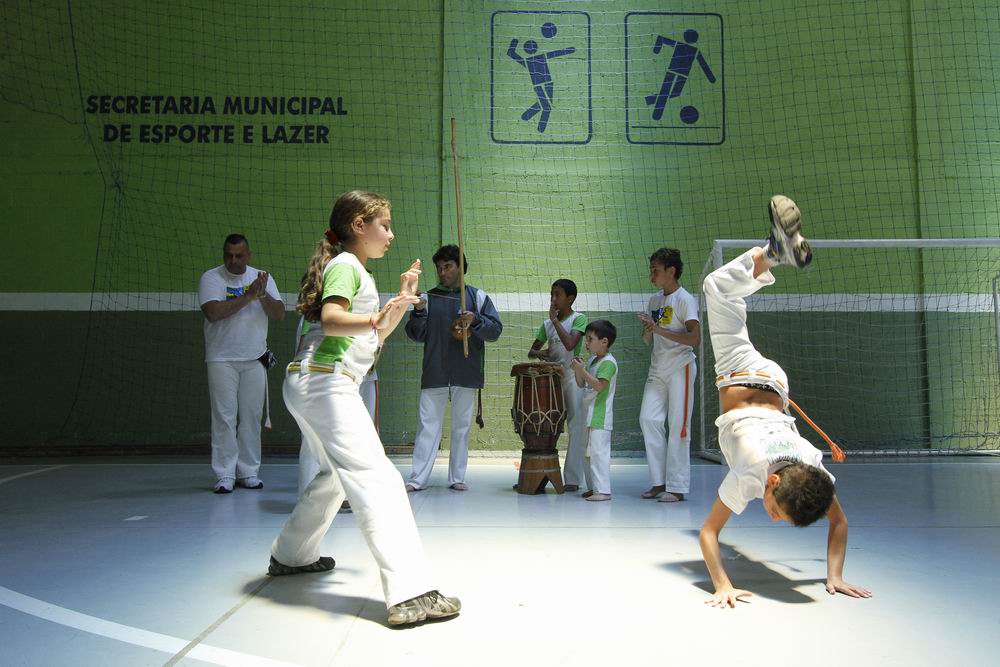
Core students Garden City - São José dos Pinhais / PR practice capoeira.
3. Develops and expands cognition
Those who practice Capoeira receive information about popular culture, the origin of the game itself, the traditions celebrated in music and songs, the instruments that encourage activity and so on. It is a knowledge transmitted every conversation wheel at the beginning of class, increasing the repertoire of the students on the formation of the Brazilian people, in short, the history of their country. This is not one type of information made to decorate, but rather stoke interest of the child by our cultural identity.
4. awakens the childlike curiosity
Those who practice Capoeira has its sound perception stimulated by the use of musical instruments, as well as body awareness is fueled by unusual movements. It is an activity that opens a range of opportunities - girls and boys can find out by playing Capoeira, a taste for folk dances, others, by singing, all of them going after specific courses. In short: a wake-up skills, valuable source of knowledge and self-love.
5. Promotes physical development
The game of Capoeira explores two opposing ways, the balance and imbalance - how do you take a tumble and then recovering the plummet - these situations of similar value, after all, the imbalance can also affect and disrupt emotionally, so be precise take strategies for balance and move in the game. All this relates to typical blows of Capoeira - including the ginga, the stingray's tail, the half moon and star. Movements that require balance and muscle tone, working with legs, arms, torso, waist etc. The student must earn elasticity, balance and self-confidence to launch into space not afraid to smash the ground. This is how children learn to recognize the limits of the body, acquiring security on own performance.
6. stimulates emotional control
Mess with the body means dealing with some of our most primitive emotions - aggression, for example. It is true that the game of Capoeira expose each student to the group, but it also can strengthen control over sensitive situations, case be ashamed for not making right a star, not having pace to sway etc. How? Capoeira lessons value the potential of each one, which has already won and can do well - after all, every child has guaranteed competencies and others to be developed. Or: all have abilities to learn and develop, each in their learning time to be respected.
Capoeira in class, the child is strongly encouraged to dance, play, play and sing. There is, therefore, shyness space - and she understands that you have to expose the group with all its imperfections. Gradually, fear or any other type of insecurity loses momentum, because the child feels more and more comfortable in the universe dominated by respect, as is the Capoeira.
Source Text: Educate to Grow.

Strong Core students Leme - Rio / RJ participate in the capoeira baptized.
Available at: < http://educarparacrescer.abril.com.br/aprendizagem/7-beneficios-capoeira-635567.shtml >
Photos source: IC Archive 2012.


